
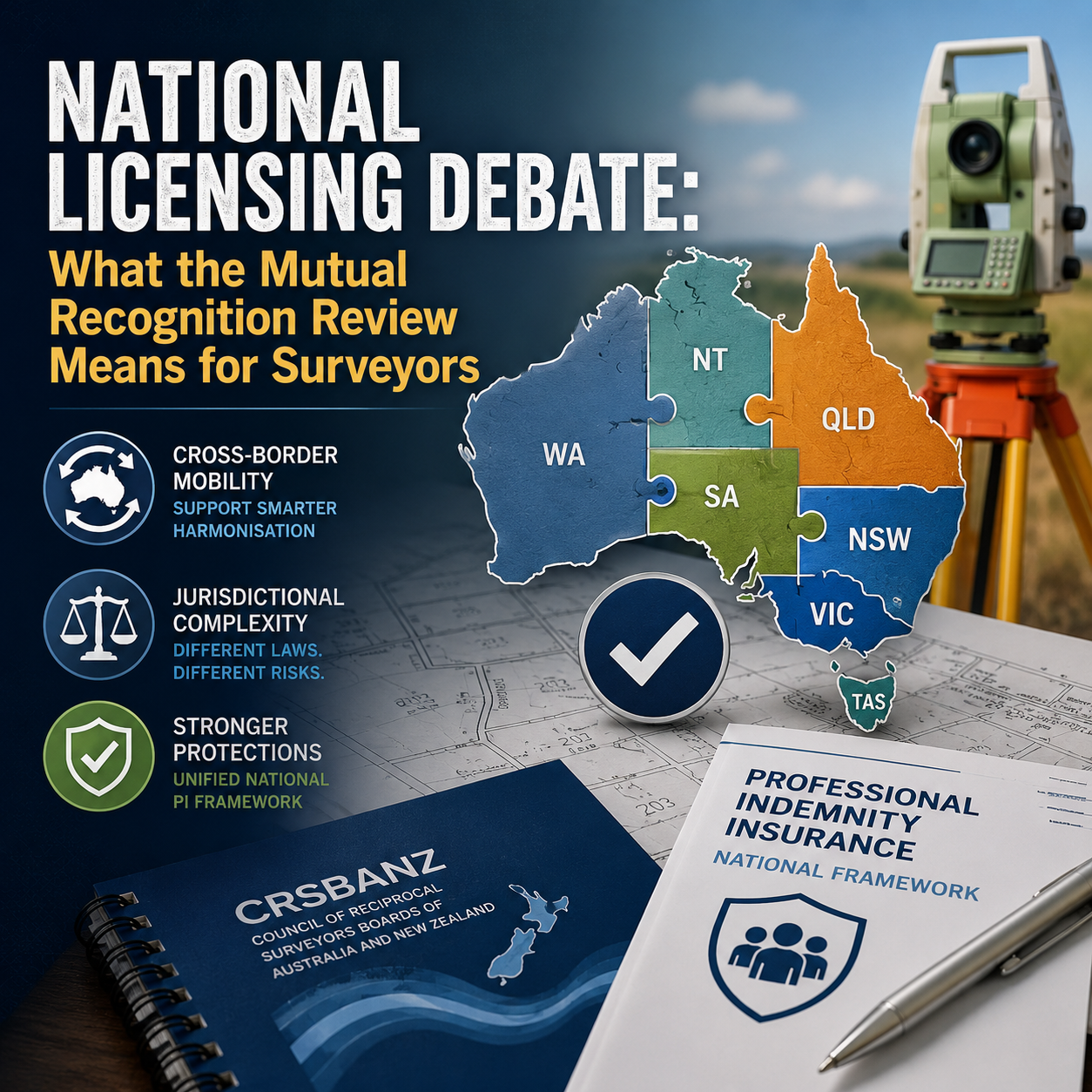
A long-running debate about how surveyors are licensed across Australian states and territories has reached a pivotal moment and the profession’s peak body is pushing back hard against a one-size-fits-all solution.
Earlier this year, Surveyors Australia lodged a comprehensive submission to the National Competition Council (NCC) as part of its review of Australia’s Mutual Recognition (MR) and Automatic Mutual Recognition (AMR) schemes. The submission argued that while cross-border mobility for surveyors is important, a blanket national licensing model would be fundamentally incompatible with the statutory and technical demands of cadastral practice.
The NCC has since released its second consultation paper and the interim findings directly reflect the arguments Surveyors Australia put forward. As the peak body noted: a 134-year history of inter-jurisdictional cooperation shows the profession doesn’t need a replacement national licence, but rather a smarter harmonisation of existing frameworks.
Why cadastral surveyors are different
The case against uniform national licensing isn’t just administrative. Cadastral surveying is legally bound to each state’s land registry and Torrens Title system, meaning the statutory obligations and the risks vary meaningfully by jurisdiction. A boundary error in one state can have entirely different legal consequences than the same error elsewhere.
That complexity is precisely why Surveyors Australia is calling for an industry-led cooperative model rather than centralised federal control. Among its eight recommendations to the NCC is a unified national framework for professional obligations, covering Codes of Conduct, Codes of Ethics, Continuing Professional Development (CPD), and Professional Indemnity Insurance, recognising that inconsistency across jurisdictions creates gaps in protection for both surveyors and their clients.
What this means in practice
For now, the existing reciprocity arrangements through CRSBANZ (the Council of Reciprocal Surveyors Boards of Australia and New Zealand) remain in place. But the review is ongoing, and any changes to how AMR applies to surveyors could affect registration requirements, cross-border work, and insurance obligations.
It’s worth keeping an eye on how this progresses, particularly if you operate across state lines or are considering it.
ACSIS will continue to monitor developments and keep members informed as the NCC finalises its findings.
Further reading
- Surveyors Australia — AMR review update: https://www.surveyorsaustralia.org.au/news-item/23542/surveyors-australia-ncc-submission-review-of-australias-mutual-recognition-scheme-for-workers
- Spatial Source — Dismantling surveying’s AMR shadow barriers: https://www.spatialsource.com.au/dismantling-surveyings-amr-shadow-barriers/